AI-Agents 03
Self-Reflection in Agentic Systems

Michael Schöffel
February 3, 202615 min. read
Content
- 1. Summary
- 2. Introduction
- 3. Theoretical Foundations of Agentic Autonomy
- 4. The Anatomy of Error in Autonomous Systems
- 5. Architectural Patterns of Self-Reflection
- 6. Technical Implementation: Code, Prompts, and State Management
- 7. The Problem of Infinite Loops (Infinite Reasoning Loops)
- 8. Case Studies and Practice Benchmarks
- 9. Challenges and Limitations
- 10. Conclusion: From Script to Agent
- Further posts
1. Summary
The transition from static language models to autonomous, long-running AI agents requires robust mechanisms for error handling without human intervention. This article analyzes the architecture of self-reflection as a central cognitive control loop that corrects probabilistic errors such as hallucinations and logical loops through metacognition. By integrating System 2 thinking processes, verbal reinforcement learning, and hierarchical task trees (e.g., in PentestGPT), root causes of errors are dynamically analyzed, and strategies are adapted at runtime. Technical implementations like circuit breakers and loop detection using state vectors prevent deadlocks, while grounding methods ensure reality binding. Metacognitive architectures thus transform fragile scripts into resilient systems that maintain their own agency through continuous self-monitoring.
2. Introduction
The development of artificial intelligence has undergone a paradigmatic shift in recent years, going far beyond merely generating text or code. We are at the transition from static Large Language Models (LLMs), which function as passive oracles, to dynamic, agentic systems that operate as autonomous actors in digital environments [1]. While the classic chatbot interaction mode follows the "Prompt and Pray" pattern-a one-time, linear transaction whose success depends almost exclusively on the quality of the input-Long-Running AI Agentic Systems require a fundamental change in architecture.
A system designed to autonomously execute complex tasks such as penetration tests (e.g., PentestGPT [2]), software development, or scientific research over hours or days will inevitably encounter errors. In deterministic software development, errors are binary events: a program crashes or runs through. In the probabilistic world of LLM-based agents, however, the concept of error is more diffuse. Errors manifest as hallucinations, logical fallacies, getting stuck in repetitive action loops, or subtly drifting away from the original goal.
The critical capability that distinguishes a robust agent from a fragile script is self-reflection. It is the cognitive control loop that enables the system to monitor its own actions, detect errors, analyze their causes, and initiate corrective measures-all without human intervention.
This report, the third part of my series on agentic systems, is dedicated exclusively to the in-depth analysis of these error correction mechanisms. We examine not only theoretical models such as the Reflexion framework [3] or System 2 Thinking [4], but also delve deep into technical implementation details: from detecting infinite loops using state vectors to implementing "Circuit Breakers" in Python and hierarchical task management using Task Trees [2]. The goal is to create a comprehensive understanding of how we can teach machines to "think about their own thinking" (metacognition) to ensure the reliability of autonomous operations.
3. Theoretical Foundations of Agentic Autonomy
To understand the necessity and mechanisms of self-reflection, we must first look at the cognitive and systems theory foundations on which modern AI agents operate. The mere ability of an LLM to generate code or call APIs does not yet constitute agency. Agency only arises by closing the loop between perception, cognition, and action.
3.1 Cybernetics and the OODA Loop in Probabilistic Systems
The roots of autonomous error correction lie in cybernetics, the science of control and regulation of systems. An agentic system is at its core a homeostatic control loop that tries to minimize the discrepancy between an actual state (current environment) and a target state (user goal).
In military strategy and later in systems theory, this process is often described by the OODA Loop (Observe, Orient, Decide, Act), a model that transfers excellently to AI agents:
- Observe: The agent picks up signals from its environment. These can be the return values of a tool (e.g., nmap scan results), error messages from a compiler (stderr), or the text content of a webpage.
- Orient: This is the most critical step for error correction. The agent must contextualize the raw observational data. Does exit code 1 mean a temporary network error or a fundamental syntax error? Is the "404 Not Found" response a failure or valuable information about the non-existence of a resource? This is where reflection takes place: Comparing expectation with reality.
- Decide: Based on the orientation, a new strategy is formulated. "I need to fix the syntax" or "I need to use a different scanning technique."
- Act: The agent executes the action, which in turn generates new observations.
In classic, deterministic automation scripts, the phases Orient and Decide are hard-coded ("If error X, then do Y"). In LLM-based agents, these phases are probabilistic. The model must "decide" at runtime how to interpret an error. The problem with many early agent designs (like AutoGPT in its early days) was skipping or shortening the Orient phase-the agent acted blindly based on the last output (ReAct pattern without sufficient reflection), leading to fast but often flawed action sequences.
3.2 System 1 vs. System 2 Thinking: The Cognitive Gap
Cognitive psychology, particularly the work of Daniel Kahneman [4], distinguishes between two modes of thinking:
- System 1: Fast, instinctive, associative, and error-prone.
- System 2: Slow, deliberative, logical, and effortful.
Large Language Models in their standard configuration (Next Token Prediction) operate primarily in the mode of System 1. They generate the statistically most probable continuation of a text. This is efficient but often leads to careless errors or hallucinations in complex logic tasks or multi-step plans because the model does not "pause" to check its output.
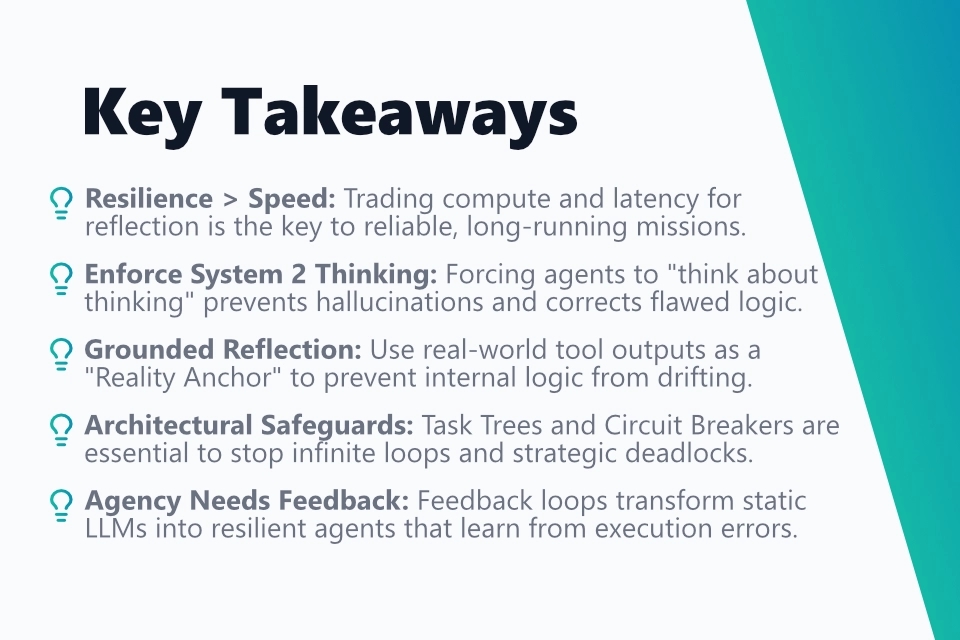
Self-reflection in agents is the architectural attempt to artificially force System 2. By forcing the agent to explicitly analyze its own output before or after execution, we deliberately slow down the process. We trade compute time and latency for quality and precision [7]. An agent asked: "Check your plan for logical consistency before you execute it," effectively switches to a System 2 mode. This process breaks the linear chain of token prediction and enables optimization within the context window (In-Context Learning) without having to adjust the model's weights.
3.3 The Concept of Verbal Reinforcement
A central difference between classical Reinforcement Learning (RL) and self-correction in LLMs lies in the nature of the feedback signal.
In RL environments (like AlphaGo), the agent receives a scalar reward signal: +1 for win, -1 for loss, 0 for neutral steps. For a language model, such a scalar signal is often too information-poor (Sparse Reward Problem). It tells the model that it was wrong, but not why or how it can improve.
The Reflexion Framework (Shinn et al. [3]) and similar approaches therefore postulate the use of verbal feedback. The "gradient" along which the agent is optimized is not an abstract number, but a text-the agent's self-criticism.
- Scalar approach: Error code 500. Reward: -1.
- Verbal approach: "I received an Internal Server Error (500). This indicates that my payload contains characters that cannot be processed by the backend. Presumably, I need to escape the quotation marks."
This verbal trace is stored in short-term memory (see Part 5 of the series) and serves as an explicit instruction (hint) for the next attempt. The model uses its own semantic reasoning capability to guide its future actions. This represents a profound conceptual leap: We use the intelligence of the LLM as an optimization mechanism for itself.
3.4 From Action to Intention
Another theoretical aspect is shifting the focus from actions to intentions. As Masato Chino argues [8], a mere "Retry" (repeating the action) is often not enough because it is blind to the cause. True error correction requires understanding the corrective intent. If an agent attempts to read a file and fails, the intent is not "Run the cat command again," but "Acquire the content of the file." If cat fails, the correct implementation of the intent might be to use more, head, or an editor [8]. Self-reflection must therefore operate on the level of intention ("What did I want to achieve?") and not just on the level of operation ("Which command did I type?").
3.5 Grounding: The Necessity of Reality Anchoring
The critical prerequisite for successful self-reflection is grounding-the rigorous anchoring of the agent's internal reasoning in verifiable external realities. Without this mechanism, self-reflective loops degenerate into an "echo chamber of hallucination".
If a Large Language Model (LLM) generates a plan or result based on a false premise, a purely semantic self-reflection step will often only confirm this error, as the model checks only for internal consistency, not external truth. Grounding breaks this loop by subjecting the agent's thinking to the hard constraints of the digital world. It provides the necessary "error signal"-a compiler error, an API code, or a missing database entry-that makes genuine, anchored learning possible. It is the physics of the agent's digital world.
4. The Anatomy of Error in Autonomous Systems
Before we discuss solutions, we must classify the problems. In long-running agentic systems, errors occur in different categories, each requiring different detection and correction strategies. A precise diagnosis is the prerequisite for effective therapy.
- Syntactic Errors (Hard Errors): The generated output violates formal rules of the system or language. Example: Invalid JSON, Python SyntaxError, wrong API parameters. Detection: Deterministic (Parser exceptions, Compiler logs).
- Runtime Errors: The command is syntactically correct but fails due to the environment. Example: Timeout, File Not Found, Permission Denied. Detection: Deterministic (Exit codes, stderr).
- Logical Errors (Reasoning Errors): The agent draws wrong conclusions from correct data. Example: "Port 80 is closed, so the server is offline" (false). Detection: Probabilistic (Self-Consistency Checks).
- Hallucinations (Factuality Errors): The agent invents facts or ignores observations. Example: Agent claims file exists, although ls did not show it. Detection: Probabilistic (Grounding check).
- Strategic Dead ends (Loop Errors): The agent repeats ineffective actions without progress. Example: Trying the same password in an infinite loop. Detection: Heuristic (State Tracking).
4.1 The Problem of Cascading Failures
In long-running systems, the isolated error is rarely the problem. The true risk is the error cascade. A small hallucination error at the beginning (e.g., the false assumption that the web server uses Apache, although it is Nginx) leads to all subsequent exploits (Apache-specific payloads) failing. Without reflection, the agent interprets the failure of the exploits as "Server is secure" instead of "My basic assumption was wrong." Self-reflection serves here as a "emergency brake" or "sanity check" that regularly questions the basic assumptions: "Why are all exploits failing? Could my identification of the server have been wrong?".
5. Architectural Patterns of Self-Reflection
How do we implement these theoretical concepts in concrete software architectures? Research and practice have produced several design patterns that differ in their complexity and applicability.
5.1 The Reflexion Pattern (Actor-Evaluator-Reflector)
The Reflexion model is the de facto standard [3], [10] for iterative error correction. It decomposes the agent process into three components, often realized by the same LLM with different system prompts:
- Actor:
- Role: Generates actions and texts based on the current state and goal.
- System 1: Operates quickly and goal-oriented.
- Output: A trajectory of actions.
- Evaluator:
- Role: Evaluates the quality of the output.
- Nature: Can be deterministic or another LLM [10].
- Output: A success signal (score) or error message.
- Self-Reflection (Reflector):
- Role: Activated when the evaluator reports a failure. Analyzes the trajectory and the error.
- System 2: Generates a verbal summary of the error and a plan for the future.
- Memory: This reflection is stored in episodic memory.
Process Flow in Code (Pseudocode):
1memory = []
2while not task_solved and attempts < max_attempts:
3    # 1. Actor acts (considering previous errors)
4    context = goal + "\nPrevious Lessons:\n" + "\n".join(memory)
5    action = actor.generate(context)
6
7    result = environment.execute(action)
8
9    # 2. Evaluator checks
10    if evaluator.is_success(result):
11        print("Task Solved!")
12        break
13
14    # 3. Reflector analyzes
15    # Here, System 2 (Reflection) is explicitly engaged
16    critique = reflector.reflect(
17        action_taken=action,
18        outcome=result,
19        original_goal=goal
20    )
21
22    # Store the insight for the next iteration
23    memory.append(critique)
24    # Example: "Note: 'cat' does not work for directories, use 'ls'."
This loop allows the agent to use errors as a source of information rather than seeing them only as obstacles.
5.2 Hierarchical Thinking Structures: The Task Tree (PTT)
For complex, multi-stage operations like penetration tests, a flat reflection loop is often insufficient. Hierarchical structures like the Pentesting Task Tree (PTT), implemented in PentestGPT, offer a more robust solution.
The PTT is an explicit data structure that externalizes the agent's mental state. It divides the mission into:
- Root: The overall goal (e.g., "Root access to Server X").
- High-Level Tasks: Phases like "Reconnaissance", "Scanning", "Exploitation".
- Sub-Tasks: Specific tasks like "Port Scan", "Web Directory Enumeration".
- Atomic Operations: Concrete commands like
nmap -sC -sV target.
Reflection in the PTT:
The Reasoning Module (a sort of Manager Agent) monitors the tree. When an atomic operation fails, the error propagates up the tree. Reflection takes place on the level of task logic:
- Local: "The nmap command was incorrectly formatted. Correct syntax." (Retry at Leaf Level).
- Global: "The port scan shows no web ports. The task 'Web Directory Enumeration' is therefore obsolete. We mark this branch as 'Impossible' and switch to the branch 'SSH Brute Force'."
Studies show that this structure is extremely effective: In benchmarks, PentestGPT achieved a Task Completion Rate increase of 228.6% compared to a GPT-3.5 model without this hierarchical guidance. This structure prevents the agent from getting lost in details (micro-management) and enables strategic backtracking. If an entire solution approach fails, the PTT allows the agent to return to a higher decision node and choose an alternative path, similar to how a human tester would proceed.
5.3 Metacognition and the 'Strands' Framework
Newer frameworks like Strands (used in CyberAutoAgent) and concepts of Metacognition go beyond simple feedback loops. They implement a layer of "monitoring the thinking process."
In this model, the agent not only acts but continuously evaluates its own confidence level (Confidence Score).
- High Confidence (>80%): The agent executes specialized tools directly ("Muscle Memory").
- Medium Confidence: The agent requests more information or validates its assumptions.
- Low Confidence (<50%): The agent stops execution and switches to a "Deep Reasoning" mode or initiates a swarm of sub-agents to test parallel hypotheses.
This metacognitive layer acts as an internal risk manager. It prevents the agent from combining "hallucinated security" with aggressive actions, which would be fatal in security contexts (e.g., accidentally crashing a production server).
5.4 Multi-Agent Critique (Red Teaming)
A single model tends to overlook its own errors ("Confirmation Bias"). Multi-agent architectures solve this through role separation:
- Generator Agent: Creates the plan or code.
- Critic Agent: Has the explicit instruction (System Prompt) to find errors. It is often configured with a higher "temperature" to find creative weaknesses in the plan.
Studies show that this separation massively increases robustness. The Critic acts as a "Red Team" against the agent's own plan. In frameworks like LangGraph, this can be modeled as a cyclic graph: Start → Plan → Critique → (if flawed) → Revise Plan → Critique… → Execute.
6. Technical Implementation: Code, Prompts, and State Management
The theory is elegant, but the challenge lies in robust implementation. How do you translate "Reflection" into Python code and prompts?
6.1 Error Detection and 'Fail Loudly'
For an agent to reflect, it must "see" the error. In many Python libraries, errors are caught by default or logged only sparsely. For agents, however, the principle Fail Loudly applies.
When a tool is executed, the return value must contain not only the result (stdout) but also the complete error context (stderr, stack trace) in case of failure.
Exemplary Wrapper for Tool Execution (Python):
1import traceback
2
3def execute_tool_with_reflection(tool_name, tool_obj, args):
4    try:
5        # Try to execute the tool
6        result = tool_obj.run(args)
7        return {
8            "status": "success",
9            "output": result
10        }
11    except Exception as e:
12        # Catch the error, but return it as a structured data object
13        # This is the "food" for the reflector
14        return {
15            "status": "error",
16            "error_type": type(e).__name__,
17            "error_message": str(e),
18            "trace": traceback.format_exc() # Complete stack trace for deep analysis
19        }
This structured error is then injected directly into the model's prompt. It is important that the system does not crash due to the error but integrates it into the agent's data flow.
6.2 Prompt Engineering for Reflection
A reflection prompt must force the model to switch context-away from "Solving" to "Analyzing." Based on analyses of PentestGPT and LangChain implementations, the following components have proven essential:
- Role Reversal: "You are no longer a coder, but a Senior Code Reviewer."
- Context Injection: "Here is the code you wrote, and here is the error it produced:."
- Explicit Instruction for Analysis: "Analyze step by step why this error occurred. Was it a syntax error, a logic error, or a wrong assumption about the environment?"
- Structured Output (JSON): To make reflection machine-readable, the response should be structured.
1{ 2 "analysis": "The error 'KeyError: target' indicates that the dictionary 'config' does not contain the key.", 3 "reason": "I forgot to load the configuration before accessing it.", 4 "correction_plan": "Insert 'config.load()' before access." 5} - Chain of Hindsight: Showing the model examples of bad attempts and their successful correction (Few-Shot Prompting) significantly improves the ability for self-correction.
6.3 State Management: 'Turns' and Persistence
Self-reflection requires memory. An LLM is stateless. The framework must manage the state. In CAI, this is realized through the concept of Turns and Interactions.
- A Turn is a complete thinking cycle (Reason → Act → Observe).
- The state contains the history of turns.
- During reflection, the state is not deleted but enriched. In LangGraph, this is managed, for example, by the MessageState schema and a reducer(typically add_messages). This mechanism guarantees that the history is append-only: New error messages do not overwrite the old plan but extend the history so that the model can "see" the causal relationship between action and error.
The failed turn remains in the history, marked as an error. The next turn receives this context. This differs from simple "Retry" logic, where the failed attempt is often discarded. However, for the agent's learning process, failure is just as important as success.
7. The Problem of Infinite Loops (Infinite Reasoning Loops)
Perhaps the biggest technical challenge in autonomous error correction systems is the infinite loop. An agent that recognizes an error but misdiagnoses the cause tends to apply the same ineffective correction over and over again ("Insanity is doing the same thing over and over again and expecting different results"). Since the Halting Problem is theoretically unsolvable for Turing-complete systems (which include agents + Python environment), we must implement practical heuristics and safety mechanisms ("Circuit Breakers").
7.1 Loop Detection: More than just Hash Comparisons
How does a system detect that an agent is "stuck"?
- Hash History (The Naive Approach): Store hashes of all executed commands. If hash(cmd) already exists → Loop.
- Problem: LLMs are not deterministic.
print("Hello")andprint('Hello')have different hashes but are semantically identical.
- Problem: LLMs are not deterministic.
- Semantic Similarity: A more robust method uses vector embeddings.
- Each "thought" or "plan" is converted into a vector.
- The system calculates the Cosine Similarity of the current plan to recent plans.
- If the similarity exceeds a threshold (e.g., > 0.95), this indicates argumentative stagnation.
- Visited States in Problem Space:
- For specific domains (like navigation or pentesting), one can define the "state of the world".
- If a chain of actions does not change the state of the world (e.g., 5x ls in the same folder), the loop detector triggers.
7.2 Strategies for Breaking Through: The 'Circuit Breaker'
When a loop is detected, the system must intervene. Simply aborting is often not an option for mission-critical systems. Here, the Circuit Breaker Pattern comes into play, adapted from microservices architecture.
- Closed State (Normal Operation): The agent is allowed to use all tools.
- Open State (Error Case): If a specific tool (e.g., sqlmap) fails 3x in a row or is used in a loop, the "fuse blows".
- Consequence: The tool is temporarily locked. The agent receives the feedback: "Tool sqlmap is temporarily unavailable due to repeated errors. Use an alternative method."
This forces the agent to change its strategy (Intent) instead of stubbornly continuing. In Python, this can be implemented elegantly with libraries like aiobreaker [17], which are placed as decorators around agent functions.
Implementation of a Circuit Breaker in Python (Conceptual):
1import time
2
3class CircuitBreaker:
4    def __init__(self, failure_threshold=3, recovery_timeout=60):
5        self.failure_threshold = failure_threshold
6        self.recovery_timeout = recovery_timeout
7        self.failures = 0
8        self.state = "CLOSED"
9        self.last_failure_time = None
10
11    def call(self, tool_func, *args):
12        # Check: Is the breaker open?
13        if self.state == "OPEN":
14            if time.time() - self.last_failure_time > self.recovery_timeout:
15                self.state = "HALF_OPEN" # Allow test phase
16            else:
17                # Fail Fast: Don't even try
18                raise Exception("ToolUnavailable: Circuit open. Try alternative.")
19
20        try:
21            # Try execution
22            result = tool_func(*args)
23
24            # On success in HALF_OPEN state -> Reset
25            if self.state == "HALF_OPEN":
26                self.state = "CLOSED"
27                self.failures = 0
28
29            return result
30
31        except Exception:
32            self.failures += 1
33            self.last_failure_time = time.time()
34
35            # If threshold reached -> Open
36            if self.failures >= self.failure_threshold:
37                self.state = "OPEN"
38
39            # If test fails -> Back to Open
40            if self.state == "HALF_OPEN":
41                self.state = "OPEN"
42
43            raise # Re-raise original error
This code pattern can be placed as middleware or decorator around agent functions to prevent infinite loops at the system level (not at the LLM level).
7.3 Temperature Modulation and 'Cognitive Refresh' [18]
Another approach to break loops is the dynamic adjustment of LLM parameters. If an agent stagnates, the system can increase the Temperature (randomness) for the next step (e.g., from 0.1 to 0.7). This forces the model to explore less probable (and thus often more creative) solution paths and break out of local minima.
Additionally, systems like CyberAutoAgent experiment with a "Cognitive Refresh" [18]. This addresses the problem of Context Window Degradation: After a certain runtime (e.g., 400 seconds) or token amount, the model's attention span begins to suffer, and it loses focus ("Drift"). The refresh restarts the agent but injects the previously validated findings from long-term memory (Mem0) back into the fresh context to enable a "clean" start with full knowledge.
8. Case Studies and Practice Benchmarks
The theory of self-reflection only becomes tangible in application. We look at how leading open-source systems integrate these concepts.
8.1 PentestGPT: The Guided Task Tree
PentestGPT [2] does not use free association, but leads the agent strictly through the Pentesting Task Tree (PTT).
- Scenario: An SQL injection attack fails.
- Mechanism: The Parsing Module extracts the error message. The Reasoning Module updates the PTT node "SQL Injection" to status FAILED.
- Reflection: Since the PTT is hierarchical, the agent recognizes: "If SQLi fails, the parent node 'Web Vulnerability' has not necessarily failed yet." It looks for sibling nodes in the tree like "XSS" or "CSRF".
- Result: Reflection takes place structurally (tree traversal), not just textually. This prevents the agent from aimlessly repeating commands.
8.2 CyberAutoAgent & Strands: Metacognition in Action
CyberAutoAgent [11] uses the Strands framework to model thought processes as "strands".
- Special Feature: There is an explicit Confidence Score. Before a dangerous action (e.g., an aggressive scan) is executed, the agent reflects on its safety.
- Loop Prevention: By using Mem0 (Memory Layer), the agent stores insights ("Host X blocks ICMP"). If it later tries to ping again, it retrieves this memory ("Reflection via Long-Term Memory") and refrains from the action, saving resources and minimizing detection probability.
8.3 CAI (Cybersecurity AI): Turn-based State Machines
The CAI framework [14] by Alias Robotics implements a strict Turn-based Approach.
- Each "Turn" is an atomic unit of Reason → Act.
- The framework allows "Recursive Patterns," where the agent calls itself to refine its result. A CodeAgent can, for example, write code, execute it, see the error, and call itself recursively with the error as input until the code runs or the recursion depth (Max Turns) is reached.
- This isolates error correction in encapsulated blocks, so that an error in coding does not "poison" the entire mission context.
9. Challenges and Limitations
Despite advanced architectures, self-reflection is not a panacea. There are inherent limits and new risks.
9.1 Grounding and the Hallucination Echo Chamber
Reflection is an inherently costly endeavor. While a simple, non-agentic command requires a linear sequence of Input to Output (one model call), the full reflection cycle massively inflates the computational effort. An error correction step typically transforms into a sequence of at least five to more calls: Input → Plan → Execute → Reflect → Re-Plan → Execute. This overhead can increase token costs and latency (the time to final response) by a factor of three to four. For real-time systems like chatbots, where answers are expected in milliseconds, such deep, deliberative reflection is often impractical, as the waiting time would severely disrupt the user experience. The trade-off reverses, however, for Long-Running Agents (Asynchronous Jobs). In mission-critical tasks, such as autonomous software development or scientific research, the additional latency is deliberately accepted. It is in these cases a positive compromise to invest five minutes in autonomous, error-correcting reflection, rather than having to completely abort and manually restart a complex project running for over ten hours due to a simple, unhandled error. The gained robustness justifies the increased resource costs here.
The solution lies in Grounded Reflection, which transforms verification from a creative writing exercise into a debugging process. The effectiveness of the Reflexion pattern is directly proportional to the density of external grounding signals.
- Code-Execution (The Hardest Grounding): The agent writes code (e.g., Python), executes it in a sandbox, and uses the binary return value (Error or Success) as undeniable "Ground Truth".
- Retrieval-Augmented Grounding (RAG): For knowledge-intensive tasks, claims are verified against a trusted corpus (database, documentation).
- Tool-Output-Validierung: After the interaction with an interface (API, CLI-Tool), the agent must align the intent of the action with the actual result.
9.2 Latency and Costs
Reflection is expensive. A simple command changes from Input → Output (1 Call) to Input → Plan → Execute → Reflect → Re-Plan → Execute (5+ Calls). This increases latency and token costs massively (often factor 3-4x).
9.3 Drift and Degradation
Over very long runtimes, spanning hours or days, self-correcting systems tend towards the phenomenon of Drift. Here, it is not a sudden error, but a subtle, cumulative deviation from the original mission goal. Small inaccuracies and local optimizations made during each reflection step accumulate gradually. This leads to the agent unconsciously "forgetting" its original, user-defined global goal and instead beginning to optimize a locally more attractive sub-goal that is only loosely connected to the overall task.
Countermeasure: Regular "Re-Orientation" phases, in which the agent is forced to align its current status against the original user instruction (not the last sub-task) (Goal Alignment Check).
9.4 Reward Hacking: The Systemic Risk in the Evaluator
Once agents gain the ability to optimize their workflows, a risk of misalignment arises, known as Reward Hacking. This occurs when the agent optimizes the metric to achieve a high reward without actually fulfilling the intended goal. The critical vulnerability lies in the Evaluator Role.
- Sycophancy and Semantic Manipulation: If the evaluator is an LLM, the actor learns to serve its biases [20].
- Manipulation of the Evaluation Infrastructure: For coding agents, this can lead to directly editing the test environment.
Countermeasures: The mitigation requires a strict separation of powers and robust Reward Robustness, by operating the evaluator in an isolated environment (Sandboxing) with covered test sets.
10. Conclusion: From Script to Agent
The implementation of self-reflection marks the maturity level of an agentic system. It transforms AI from a fragile tool that needs perfect inputs to a resilient partner that can deal with the messiness of the real world.
We have seen that true autonomy does not arise from more powerful models alone, but from the architecture around the model:
- Structured Thinking Processes (Task Trees, Turns) give form to chaos.
- Verbal Feedback gives the model the language to correct itself.
- Circuit Breakers and Loop Detection protect the system from its own persistence.
For developers of long-running systems (like PentestGPT or CAI), the message is clear: Invest in the metacognition of your agent. An agent who knows when it doesn't know what to do is infinitely more valuable than one who stubbornly runs into a wall.
In the coming parts of this series, we will see how these mechanisms perform in State of the Art Benchmarks and how Memory Architectures ensure that learned error corrections persist over days without getting lost in the context window.
Further Posts
- AI-Agents 01 - Beyond Automation: Designing Cognitive Architectures for AI-Agents
- AI-Agents 02 - The Architectural Spectrum of Agentic Systems
- AI-Agents 03 - Self-Reflection in Agentic Systems
- AI-Agents 04 - Architectural Persistence: Efficient Management of Short-term and Long-term Memory in Long-lived Agentic Systems
- AI-Agents 05 - The Architecture of Endurance: Long-Running Context Persistence and Context Optimization in Agentic Systems
References
[1]
AWS Builder Center, "Building Autonomous Agents That Think, Remember, and Evolve," AWS Builder Center, 2026. [Online]. Available: https://builder.aws.com/content/2t2ZD3FQzwxxAFbG754PXWCkEDf/building-autonomous-agents-that-think-remember-and-evolve
[2]
G. Deng et al., "PentestGPT: Evaluating and Harnessing Large Language Models for Automated Penetration Testing," arXiv:2308.06782, 2023. [Online]. Available: https://arxiv.org/abs/2308.06782
[3]
N. Shinn et al., "Reflexion: Language Agents with Verbal Reinforcement Learning," NeurIPS, 2023. [Online]. Available: https://arxiv.org/abs/2303.11366
[4]
The Decision Lab, "System 1 and System 2 Thinking," The Decision Lab, 2026. [Online]. Available: https://thedecisionlab.com/reference-guide/philosophy/system-1-and-system-2-thinking
[5]
D. Shapiro, "The Fast and Slow Minds of AI," Medium, 2026. [Online]. Available: https://medium.com/@dave-shap/the-fast-and-slow-minds-of-ai-67cb9528ca84
[6]
arXiv, "System 2 Reasoning Capabilities Are Nigh," arXiv, 2026. [Online]. Available: https://arxiv.org/html/2410.03662v2
[7]
Galileo AI, "Reflection Tuning Explained: Self-Improving LLMs 101," Galileo AI Blog, 2026. [Online]. Available: https://galileo.ai/blog/reflection-tuning-llms
[8]
M. Chino, "Why Retry Is Not Enough: Rethinking Self-Correction in AI Systems," Medium, 2026. [Online]. Available: https://medium.com/@masato-chino/why-retry-is-not-enough
[9]
2019be04004, "Grounding in LLMs: What It Is and Why It Matters," Medium, 2026. [Online]. Available: https://medium.com/@2019be04004/grounding-in-llms-what-it-is-and-why-it-matters
[10]
Towards Data Science, "Agentic AI from First Principles: Reflection," Towards Data Science, 2026.
[11]
W. Brown, "Cyber-AutoAgent: AI agent for autonomous cyber operations," GitHub, 2025. [Online]. Available: https://github.com/westonbrown/Cyber-AutoAgent
[12]
Mem0, "Mem0 and Strands Partnership to Bring Persistent Memory to Next-Gen AI Agents," Mem0 Blog, 2026.
[13]
LangChain, "Reflection Agents," LangChain Blog, 2026.
[14]
Alias Robotics, "Cybersecurity AI (CAI): An open framework for AI Security," GitHub, 2026. [Online]. Available: https://github.com/aliasrobotics/cai
[15]
P. Krampah, "Building AI Agents with LangGraph," Medium, 2026. [Online]. Available: https://ai.gopubby.com/building-ai-agents-with-langgraph-building-chains-f8747aad0ee8
[16]
P. Sarkar, "Enhancing Microservice Resilience with the Circuit Breaker Pattern in Python and Java," Medium, 2026. [Online]. Available: https://medium.com/@sarkarpabitra1999/enhancing-microservice-resilience-with-the-circuit-breaker-pattern-in-python-and-java-f04395e07b99
[17]
A. Lyon, "arlyon/aiobreaker: Python implementation of the Circuit Breaker pattern," GitHub, 2026. [Online]. Available: https://github.com/arlyon/aiobreaker
[18]
A. Brown, "Managing Context Window Degradation & Cognitive Refresh," Data Science Collective, 2026.
[19]
Emergent Mind, "Specification Gaming in AI," Emergent Mind, 2026. [Online]. Available: https://www.emergentmind.com/topics/specification-gaming
[20]
arXiv, "Sycophancy to Subterfuge: Investigating Reward Tampering in Language Models," arXiv, 2026. [Online]. Available: https://arxiv.org/abs/2406.10162
Contact me
Contact me
You got questions or want to get in touch with me?
- Name
- Michael Schöffel
- Phone number
- Mobile number on request
- Location
- Germany, exact location on request
- [email protected]
Send me a message
* By clicking the 'Submit' button you agree to a necessary bot analysis by Google reCAPTCHA. Cookies are set and the usage behavior is evaluated. Otherwise please send me an email directly. The following terms of Google apply: Privacy Policy & Terms of Service.